
Boiler leaking water: what it means and when to switch it off
- Checked September 2026
- 4 min read
- By PROS AI editorial team
Quick answer
The short version, before the detail.
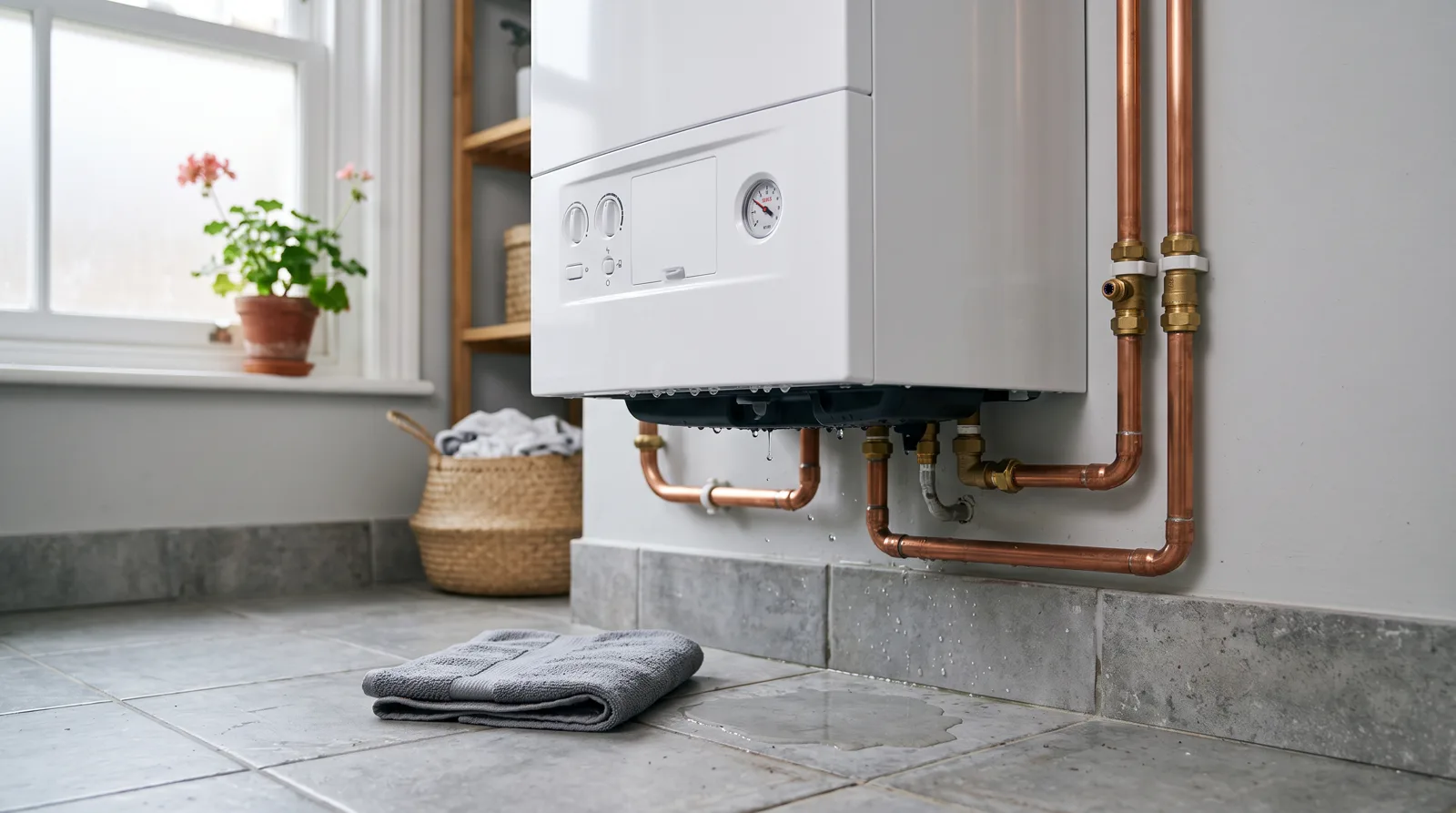
Water under or around the boiler is a stop sign, not a wait-and-see. The common sources are the pressure relief valve discharging because the pressure is too high, a worn seal or pump, a corroded pipe joint or, on an older boiler, a cracked heat exchanger. Read the gauge, switch the boiler off if water is coming from the casing, and call a Gas Safe registered engineer.
What is the likely cause?
Most common first, with how to tell.
Pressure too high, so the relief valve is discharging.
How to tell: the gauge reads over 2 bar or sits in the red, and the copper pipe that runs through the outside wall is dripping. A filling loop left slightly open does this.
The relief valve passing at normal pressure.
How to tell: the gauge is fine but that outside copper pipe is still wet. Debris or limescale is holding the valve open.
A worn seal.
How to tell: drips from the bottom edge of the casing that start or worsen as the boiler heats and cools.
A corroded pipe or joint.
How to tell: staining, green or white crust, or damp around the pipework under the boiler rather than the casing itself.
The pump.
How to tell: water at the pump, which is inside or just below the boiler, and a pump that is very hot to the touch.
A cracked heat exchanger.
How to tell: water inside the boiler and onto the floor with normal pressure and no wet joint, usually on a boiler well past ten years. Often the point where replacement wins.
Not the boiler.
How to tell: the wet patch traces back to a washing machine, dishwasher or a pipe above.
What can I safely check myself?
Everything here is done by looking and by reading the gauge. Nothing opens the casing, touches the relief valve, or tightens a joint.
- Trace the water. Follow the wet patch to its source: the white plastic condensate pipe, the copper relief pipe outside the wall, the pipework beneath the boiler, or the casing itself. Check nearby appliances too.
- Read the gauge. Cool, it should sit between 1 and 1.5 bar. If it is over 2 bar, the relief valve is doing its job. Check the filling loop valves are fully closed. Bleeding a radiator lets pressure out, slowly, and you can watch the gauge come down.
- Normal pressure and still dripping means wear inside: seals, joints, pump or heat exchanger. That is the engineer's diagnosis to make.
- Contain it. Put a container or towels under the drip and move anything electrical away from the water.
- Switch off if it is from the casing. Turn the boiler off at its fused spur, provided the switch is dry, and if the water keeps coming turn off the mains stopcock. Manufacturers say to turn off the water supply and the heating and wait for the engineer.
- Do not top up a system that is leaking. Refilling feeds the leak and can do further damage.
When do I stop and call an engineer?
- If you smell gas, leave the property, do not switch anything on or off, and call the National Gas emergency line on 0800 111 999 from outside.
- If water is running near sockets, the fused spur or the consumer unit, switch off at the main switch only if it is dry and safe to reach. If the consumer unit itself is wet, do not touch it; call an electrician.
- Any water from the casing means switch off and call. Do the same for a relief pipe that drips constantly, a gauge in the red, a steady stream rather than a drip, or a puddle that returns after you have mopped it.
- Removing the casing, the relief valve, the pump and the heat exchanger are all Gas Safe registered work. Check the seven-digit number on the engineer's ID card at gassaferegister.co.uk, or text Gas and the number to 85080.
What does it cost in London?
A weekday call-out with diagnosis in London is £60 to £125, often waived if the repair goes ahead, and labour is £80 to £140 an hour. A pressure fault, meaning the relief valve or the expansion vessel behind it, is £120 to £280 with the part; a pump is £180 to £420; a heat exchanger is £450 to £880, and on a boiler over 12 years old that is usually the point to price a replacement instead. Out of hours the first hour is £140 to £260.