
Boiler losing pressure: why it happens and how to repressurise safely
- Checked September 2026
- 4 min read
- By PROS AI editorial team
Quick answer
The short version, before the detail.
A sealed heating system loses a little pressure over a year, and topping it up once or twice is normal. Losing it every few days means water is leaving the system: a weeping radiator valve or joint, a pressure relief valve that is passing, or an expansion vessel that has failed. Repressurise to 1 to 1.5 bar, then watch how quickly it falls.
What is the likely cause?
Most common first, with how to tell.
You bled the radiators.
How to tell: the gauge dropped straight after bleeding and then holds. Bleeding lets water out with the air.
A small leak on the system.
How to tell: damp patches or staining at a radiator valve, a joint or under a floor, and a drop over days rather than hours. Radiator valves are the usual culprit.
The pressure relief valve is passing.
How to tell: the copper pipe that runs from the boiler through the outside wall is wet or dripping. In normal use it stays dry.
The expansion vessel has failed.
How to tell: the gauge climbs high when the heating runs, the relief valve discharges, and the pressure is low again once everything cools.
A leak inside the boiler.
How to tell: a puddle under the boiler, or a steady fall with no wet joint anywhere else.
The pump.
How to tell: water at the pump, or a pump that is very hot to the touch.
What can I safely check myself?
Everything here is done from the gauge, the filling loop and a torch.
- Read the gauge cold. With the heating off for an hour, the needle should sit between 1 and 1.5 bar. Below 0.5 bar, water has definitely left the system.
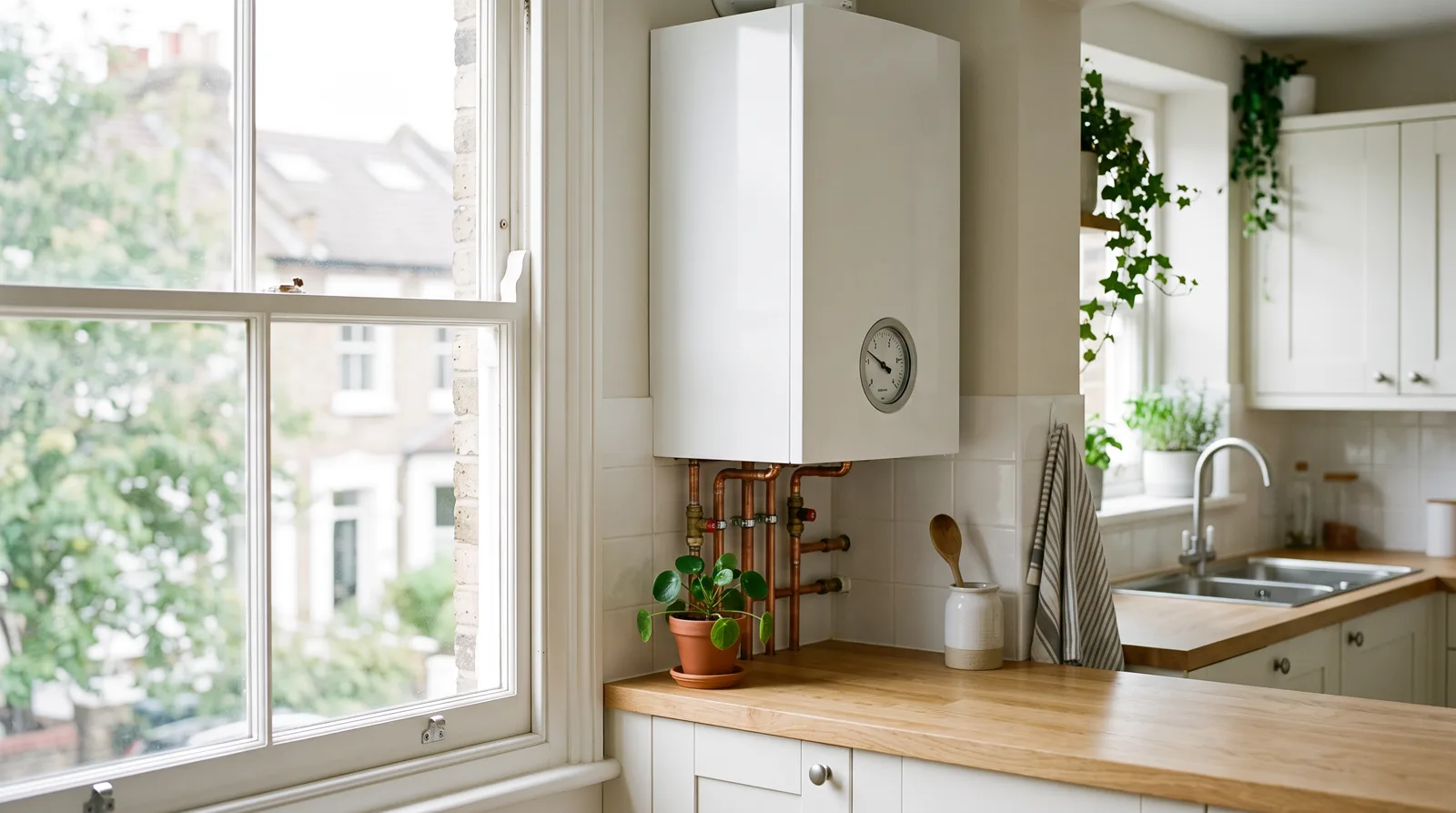
- Repressurise. Find the filling loop. Some boilers have a blue lever underneath; others have a key that turns in a port on the front; older systems have a silver braided hose with a valve at each end under the boiler. Open the valve (or pull the lever, or turn the key) and watch the needle rise. Stop at 1 to 1.5 bar, then close both valves fully. Do not go past 1.5 bar; when the heating runs the pressure rises by about half a bar on its own.
- Reset once if the boiler has locked out on low pressure. Press reset for a few seconds and wait.
- Write the reading down and check it again after 24 hours, then after a week. A drop within a day is a leak to find; a drop over a season is normal.
- Look, do not touch. Check every visible radiator valve, joint and the pipework under the boiler for damp, and look at the copper relief pipe outside the wall for drips.
- If you bled radiators recently, top up once and see if it holds.
Do not open the casing, touch the relief valve or the expansion vessel, or tighten any joint.
When do I stop and call an engineer?
- If you smell gas, leave the property, do not switch anything on or off, and call the National Gas emergency line on 0800 111 999 from outside.
- If water is dripping near the fused spur, sockets or the consumer unit, switch off at the main switch only if it is dry and safe to reach.
- Stop if the pressure falls as soon as you close the filling loop, and do not keep topping up; that is a significant leak or a relief valve fault, and repeated filling can do further damage. Stop too if you are topping up more than once or twice a year, if the outside relief pipe is wet, or if there is a puddle under the boiler. Switch the boiler off if it is dripping from the casing.
- The relief valve, the expansion vessel and anything behind the casing are Gas Safe registered work. Check the seven-digit number on the engineer's ID card at gassaferegister.co.uk, or text Gas and the number to 85080.
What does it cost in London?
A weekday call-out with diagnosis in London is £60 to £125, often waived if the repair goes ahead, and labour is £80 to £140 an hour. A pressure fault, meaning the expansion vessel or the pressure relief valve, is £120 to £280 with the part, and London firms call it the most common winter fault. A weeping radiator valve or joint is charged at the hourly rate plus the part.