
RCD or consumer unit keeps tripping: how to find the circuit, safely
- Checked September 2026
- 4 min read
- By PROS AI editorial team
Quick answer
The short version, before the detail.
An RCD that trips is doing its job: it has detected current leaking to earth, usually from a faulty appliance, damp in an outdoor socket or light, or a wiring fault. You can narrow it to one circuit and often one appliance by resetting with everything unplugged and reconnecting one thing at a time. If it trips again the moment you reset it, stop and call a registered electrician.
What is the likely cause?
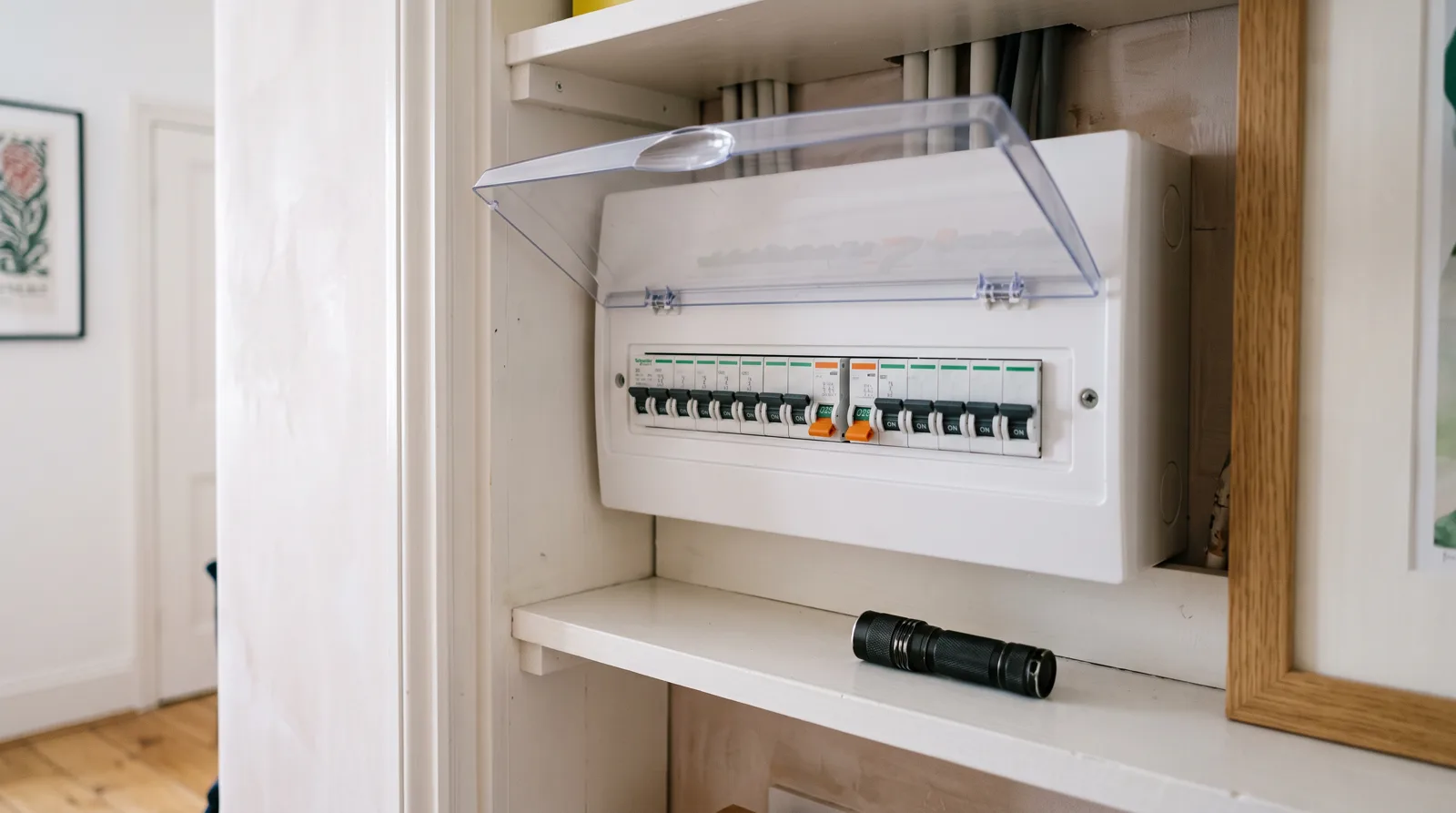
Most common first, with how to tell. First check which switch has dropped: the RCD is the wider switch with a Test or T button; a circuit breaker is one of the narrow switches, each for one circuit.
A faulty appliance.
How to tell: the trip happens when one particular appliance is switched on, or that appliance kills a second socket when you try it elsewhere. Kettles, washing machines and fridge-freezers are typical.
Damp in outdoor or garden electrics.
How to tell: the trip follows wet weather and an outside socket, garden light, pond pump or shed supply is on the same RCD. Outdoor equipment is the part of the house most exposed to water.
A wiring fault.
How to tell: the RCD trips with everything unplugged, or re-trips immediately every time you reset it.
An overload or short on one circuit.
How to tell: a single circuit breaker has dropped, not the RCD. Breakers react to overloads and short circuits; RCDs react to earth leakage.
A tired RCD.
How to tell: it trips at odd times with no pattern, or the Test button does nothing.
A power cut, not a trip.
How to tell: nothing on the consumer unit has moved and the neighbours are dark too.
What can I safely check myself?
All of this is done on the front of the consumer unit and at the sockets. Never remove the cover of the consumer unit, never open a socket, and never bypass or tape over an RCD.
- Look at the consumer unit. Find the switch that is down. If none has moved, it is a power cut: call 105, free, to reach the network operator.
- Unplug everything on the affected circuits. The circuits should be labelled on the unit. Switch off appliances at the wall as well, and close the lids on outdoor sockets.
- Reset once. Push the RCD (or the breaker) back up. If it stays up, the fault is in something you unplugged.
- Reconnect one at a time. Plug in and switch on one appliance, wait a minute, then the next. The one that drops the RCD is the culprit; leave it unplugged and have it repaired or replaced.
- Narrow it by circuit if it will not hold. If several breakers sit under one RCD, switch those breakers off, reset the RCD, then switch the breakers back on one at a time. The circuit that drops the RCD is the one to tell the electrician about.
- Press the Test button once the power is back. It should trip the RCD at once; reset it afterwards. Test it every three months.
When do I stop and call an engineer?
- Burning smell, scorching, heat, buzzing or crackling at a socket, a switch or the consumer unit: switch off at the main switch, keep it off, and call an electrician. If there is smoke or fire, call 999.
- Water in or near the consumer unit, or a socket that has been wet: switch off at the main switch only if the unit is dry and safe to reach; if it is wet, do not touch it and call an electrician.
- Stop if the RCD re-trips the moment you reset it, if it trips with everything unplugged, if the Test button does not trip it, or if anyone has had a shock, however small.
- Use an electrician registered with NICEIC or NAPIT, the government-approved competent person schemes; check the firm on electricalcompetentperson.co.uk. If a circuit or the consumer unit needs replacing, that work is notifiable and a registered firm can self-certify it.
What does it cost in London?
A weekday daytime fault-finding visit in London is £80 to £150 for the first hour and £60 to £80 an hour after that. Most tripping faults are traced and fixed within one to two hours, so £100 to £250 is the usual bill. An evening or weekend first hour is £90 to £150 and a night emergency £100 to £200. Replacing a faulty RCD or breaker is £80 to £200 fitted; if the board itself is the fault, a replacement is £500 to £900.