
Burning smell from a socket or the fuse board: switch off, then what
- Checked September 2026
- 5 min read
- By PROS AI editorial team
Quick answer
The short version, before the detail.
A burning or fishy smell at a socket, a plug or the consumer unit means a connection is overheating, and overheating connections start fires. Switch off at the main switch if it is dry and safe to reach, unplug whatever is in that socket, and leave it off. Do not reset anything and do not open a cover. If there is smoke or flame, get out and call 999; otherwise it is an electrician the same day.
What is the likely cause?
Most common first, with how to tell. A fishy note is the classic sign of a socket or plug cooking.
A plug or appliance overheating in the socket.
How to tell: the smell is strongest at one appliance, the plug is hot or discoloured, and it is a heavy load such as a heater, a tumble dryer or a kettle. Electrical Safety First's checks for plugs are cracks in the casing, melted plastic, a discoloured casing or cable, and a cable not clamped firmly in the plug.
A loose connection inside the socket.
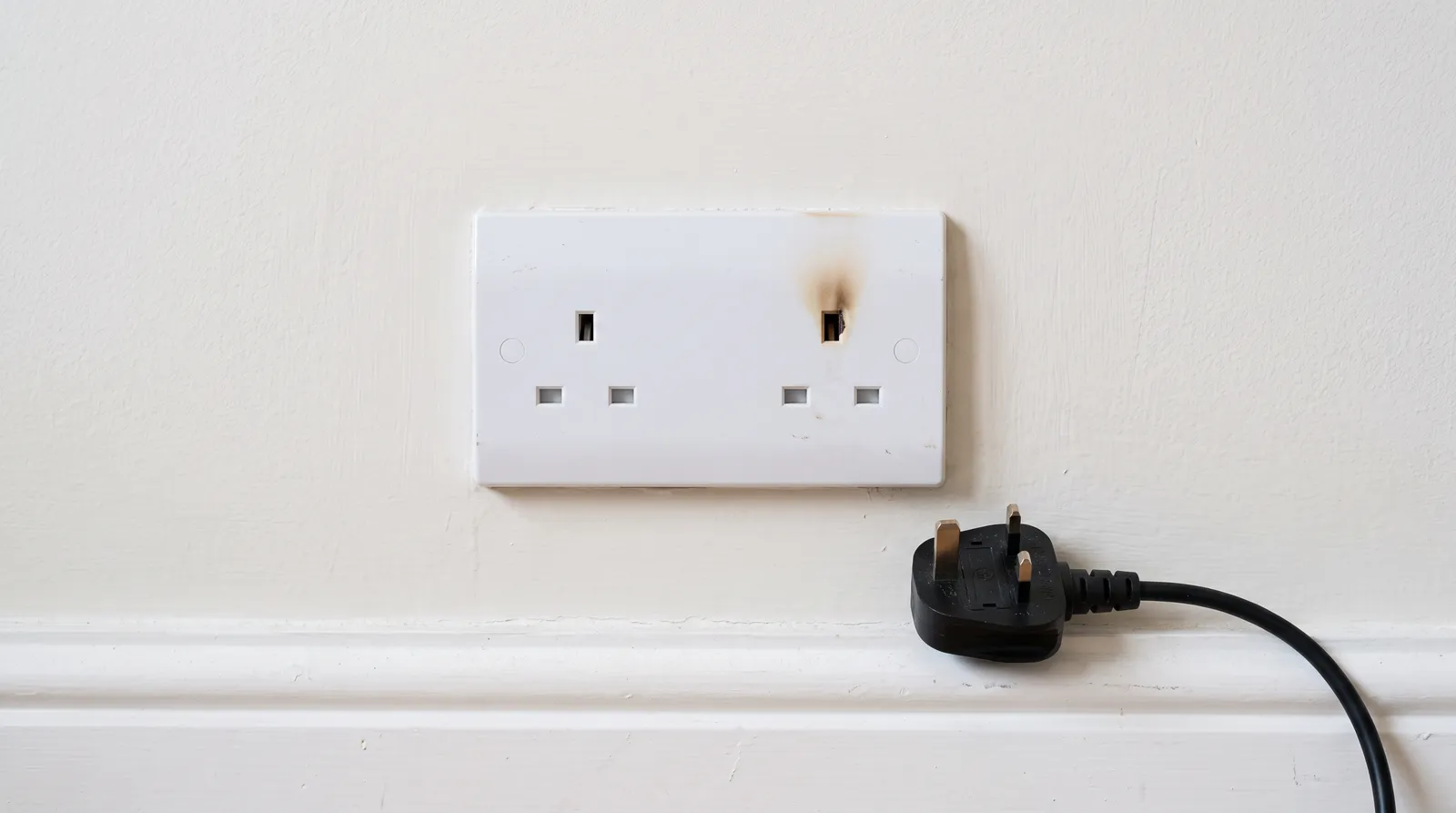
How to tell: the socket face itself is hot, yellowing or scorched, it crackles, or the fishy smell is there with nothing plugged in. NICEIC lists scorch marks, discolouration, melted plastic or smoke, a burning or fishy odour, a socket or wall that feels hot, and sparking or crackling as the signs to call an electrician for.
An overloaded extension lead or adaptor.
How to tell: the smell comes from a four-way or a cable reel with several things on it. London Fire Brigade's rule is one plug per socket for high-powered appliances, and a cable drum always fully unwound.
A loose connection at the consumer unit.
How to tell: the smell is at the board, a breaker or the main switch is warm, the board buzzes, or a breaker has been tripping for no obvious reason. This is the dangerous one, because everything in the house runs through it.
A tired or damaged device on the board.
How to tell: heat marks on one breaker or RCD, or a board with rewireable fuses and no RCD. A board with heat marks is replaced, not repaired.
Not the electrics at all.
How to tell: a new heater burning off dust on first use, or an appliance whose motor smells but whose plug and socket stay cool. Unplug it anyway and see whether the smell stops.
What can I safely check myself?
Everything here is done from the front of the consumer unit and at arm's length from the socket. Never remove the cover of the consumer unit or a socket, never touch a plug or socket that is hot, and never tape over or bypass a breaker.
- Switch off at the main switch. It is the large switch on the consumer unit, the master control for everything entering it. Do this first if the smell is at the board, or if you cannot tell where it is coming from. Only touch it if the unit is dry and safe to reach.
- Unplug. If the smell is at one socket, pull the plug out by the plug, not the cable, once it is cool enough to hold. Unplug everything else on that socket or extension lead too.
- Look, do not touch. Check the plug and the socket face for discolouration, melting or scorch marks. Photograph them for the electrician.
- Do not reset. If a breaker or RCD tripped when the smell appeared, leave it down. NICEIC's rule is that if a circuit immediately re-trips you do not try resetting it again, and a trip with a burning smell is worse than that. A tripping RCD without any smell is a different problem, covered in RCD keeps tripping.
- Check the plug fuse only once the plug is cool. If it has blown, Electrical Safety First says to replace it only with one of the same rating, 3A for low-power items and 13A for kettles and washing machines. A fuse that blows twice means the appliance is faulty; stop using it and contact the retailer or manufacturer.
- Decide what stays off. If the smell was at one socket and it is now cool, keep that socket unused, with nothing plugged in, until an electrician has opened it. If the smell was at the board, keep the main switch off and book an emergency electrician.
When do I stop and call an electrician?
- Smoke or flame from a socket, an appliance or the consumer unit: get out and call 999. London Fire Brigade's advice is to get out and call them, and not to go back in for any reason.
- If anyone has had a shock, turn off the supply at the main switch or by unplugging, never touch the person while they are in contact with the electricity, and call 999 if they are unconscious.
- Water near the consumer unit or a wet socket: switch off at the main switch only if the unit is dry and safe to reach; if it is wet, do not touch it and call an electrician.
- Stop at the point of switching off and unplugging. Every burnt socket, every warm breaker and every loose connection is found and repaired with the covers open, and that is a registered electrician's job; Electrical Safety First's advice for burn marks or a hot socket is to get a competent registered electrician to check them. Use a firm registered with NICEIC or NAPIT and check it on electricalcompetentperson.co.uk. A new consumer unit is notifiable work and a registered firm can self-certify it.
What does it cost in London?
An emergency electrician in London is £100 to £200 for the first hour at night or on a weekend, then £70 to £120 an hour; a weekday evening is £77 to £120 and a weekend £77 to £150 for the first hour. If the socket is cool and isolated and you can wait, a weekday daytime call-out is £60 to £150 and includes the first hour, and a replacement socket usually fits inside it, so the call-out is the price. Replacing a faulty breaker or RCD is £80 to £200 fitted; if the board itself is scorched, a replacement consumer unit is £500 to £900 for most London homes, £350 to £600 for a one or two-bed flat.