
Half the house has no power: tripped circuit, RCD or a supply fault?
- Checked October 2026
- 5 min read
- By PROS AI editorial team
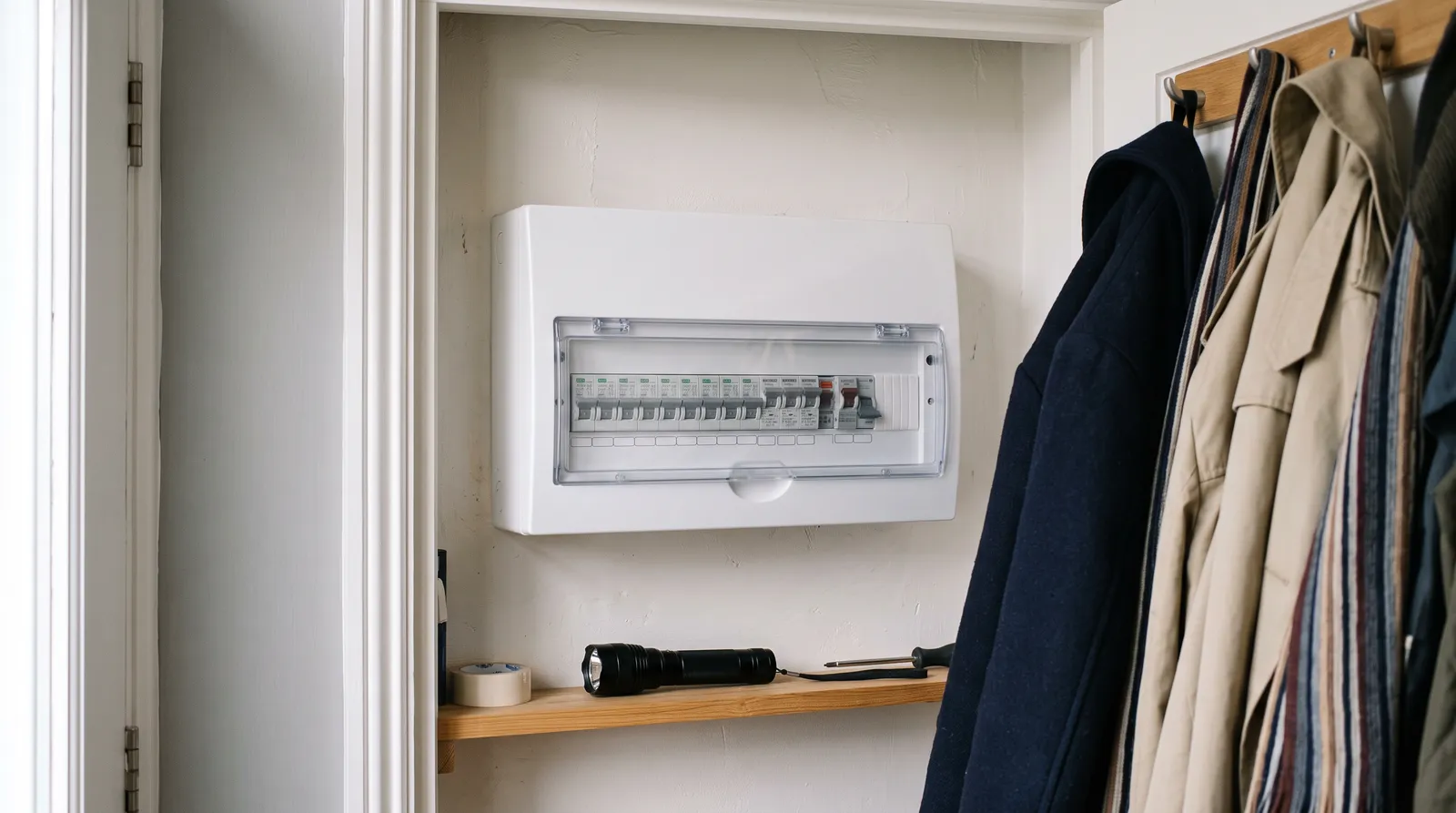
Quick answer
The short version, before the detail.
When some rooms have power and others do not, look at the consumer unit first. Many boards split the circuits between two RCDs, so one RCD tripping takes out a whole group of circuits, which can look like half the house; a single breaker takes out one circuit. Unplug everything on the dead circuits and reset once. If nothing on the board has moved, or it will not reset, it is a wiring or supply fault: ask the neighbours, report it on 105 if they are affected too, and otherwise call a registered electrician.
What is the likely cause?
Most common first, with how to tell. A breaker is one of the narrow switches, each for one circuit; an RCD is a wider switch with a Test or T button that protects a group of circuits.
One RCD has tripped.
How to tell: an RCD is down, and several circuits are dead even though their own breakers are still up. NICEIC describes dual RCD boards, where the circuits are divided between two RCDs, and Electrical Safety First says an RCD cuts the power to the areas of the home it protects.
One breaker has tripped.
How to tell: a single narrow switch is down, the dead area matches its label, such as the upstairs sockets or the downstairs lights, and everything else is normal. NICEIC says breakers trip on short circuits and overloads.
A second consumer unit.
How to tell: nothing on the main board has moved, and the dead part is an extension, a loft conversion, a garage or a garden room. Electrical Safety First warns that you might have more than one main switch.
A blown fuse in an older fuse box.
How to tell: the board has pull-out fuse holders instead of switches, so nothing looks different. Leave the fuses alone; rewireable fuses are one of the usual reasons an electrician recommends a new board.
A wiring fault.
How to tell: the switch will not reset, or it resets but the rooms stay dead, or the power went after drilling or building work. Council power cut advice says that if only part of your supply has failed and the trip will not reset, there may be a wiring fault.
A problem on the supply side.
How to tell: the main switch is on, nothing has tripped, and the neighbours have dead or dim rooms too, or the street lights are out. That is for the electricity network operator, and 105 reaches it free.
What can I safely check myself?
Everything here is done at the window, the plugs and the front of the consumer unit. Never remove the cover of the consumer unit, never touch the meter or the cables going into it, and never tape or hold a switch up.
- Ask the neighbours. If their power is off or behaving oddly too, report it to the network operator online or on 105, free in England, Wales and Scotland.
- Read the board. Find the main switch, the RCDs and the breakers, and note which switch is down and what its label says.
- If a breaker is down, unplug everything on that circuit and reset it once. NICEIC's rule is that if it trips again immediately, you do not reset it again.
- If an RCD is down, switch off the breakers under it and unplug what is on those circuits, reset the RCD, then switch the breakers back on one at a time. The one that drops the RCD is the circuit to tell the electrician about. The full method is in RCD keeps tripping.
- If nothing has moved, look for a second consumer unit, for example in a garage, a cupboard or near the meter, and check it the same way.
- While you wait, keep the fridge and freezer shut so they stay cold for several hours, switch off heaters, irons and the oven, and unplug the TV and computer, which GOV.UK says a surge can damage when the power returns. Use a torch, not candles. If someone relies on medical equipment, join the Priority Services Register, a free service for people with additional needs.
When do I stop and call an electrician?
- Burning smell, scorching, heat, buzzing or crackling at the consumer unit or a socket: switch off at the main switch if it is safe to reach, keep it off, and call an electrician. If there is smoke or fire, get out and call 999. See burning smell from a socket or the fuse board.
- Water in or near the consumer unit: switch off at the main switch only if the unit is dry and safe to reach; if it is wet, do not touch it and call an electrician.
- Stop if a switch trips again the moment you reset it, if it trips with everything unplugged, if it will not reset at all, if nothing has tripped and the neighbours are fine, if your board has old pull-out fuses, or if anyone has had a shock. If the lights on the working side flicker or dim, see lights flickering in the house and mention it when you call.
- Use an electrician registered with NICEIC or NAPIT, the government-approved competent person schemes; check the firm on electricalcompetentperson.co.uk. If the consumer unit needs replacing, that work is notifiable and a registered firm can self-certify it.
What does it cost in London?
A weekday daytime fault-finding visit in London is £80 to £150 for the first hour and £60 to £80 an hour after that. Most faults come to £100 to £250, though a damaged cable behind plaster or under a floor can take two or three hours. An evening or weekend first hour is £90 to £150 and a night emergency £100 to £200, worth paying if it will not reset and you have no power to a freezer, medical equipment or a vulnerable person. Replacing a faulty RCD or breaker is £80 to £200 fitted; if the board itself is the fault, with rewireable fuses or no RCD, a replacement is £500 to £900.